We research products independently. When you buy through links on this page, we may earn a commission from Amazon at no extra cost to you. As an Amazon Associate we earn from qualifying purchases. Read our affiliate disclosure.
Verdict: a slate pool table is worth it if you play at least weekly, want the table to last 20 years or more, and have a ground floor or basement. Choose MDF if you play casually, need to keep the budget under about $1,500, or may move the table. Slate plays truer and stays flat for decades; MDF is lighter, cheaper and easier to live with, but it can sag or warp with humidity over time.
Hybrids sit in between. Surfaces like GLD's Accuslate, Mizerak's Slatron and Barrington's Slate-Tech are stiffer than plain fiberboard, but none of them is stone.
Slate pool table vs MDF at a glance
| Slate | MDF / fiberboard | Hybrids (Accuslate, Slatron, Slate-Tech) | |
|---|---|---|---|
| Material | Quarried stone, honed flat | Medium-density fiberboard | Engineered boards or composite over wood |
| Typical thickness | 1" (WPA minimum); some 3/4" backed | 1/2" to 3/4" | Varies; Slate-Tech about 1" total |
| Pieces | Usually three, matched | Usually one | Usually one |
| Flatness over time | Excellent; unaffected by humidity | Can sag or warp | Better than plain MDF |
| Weight | Heavy (605 lb shipping for a 7 ft Brunswick Black Wolf Pro) | Light (about 250 lb for a 7 ft Hathaway Hustler) | Light to mid (192 lb for the 7 ft Fat Cat Tucson; 313 lb for the 7.5 ft Fat Cat Reno) |
| Installation | Professional | DIY | DIY |
| Typical warranty | Lifetime on the table (Brunswick, American Heritage) | 90 to 180 days | 90 days plus 7 years on the surface (GLD Accuslate) |
| Typical list price | About $2,000 to $6,000+ | About $600 to $1,500 | About $1,000 to $2,000 |
| Best for | Regular and serious players | Casual family play | Buyers who want firmer than MDF without slate weight |
| Amazon | See options | See options | See options |
Price ranges are from our pool table cost guide, based on manufacturer and dealer list prices in October 2026.
The differences, one by one
1. How it plays
The playing bed decides how true the roll is. Slate is honed flat, and a properly leveled three-piece slate bed gives a consistent roll from rail to rail, especially on slow shots near the pocket where small dips show up. That's why the WPA requires slate at least 1 inch thick for tournament tables.
MDF plays well when new. The difference shows up over time: fiberboard is less rigid, can flex slightly under load, and may develop dips. Thin beds are worse; a 1/2-inch MDF bed on a folding table plays noticeably livelier and less consistently than a 3/4-inch bed.
2. Durability and humidity
This is slate's biggest advantage. Slate doesn't absorb moisture, so it won't swell, sag or warp in a humid basement. MDF is wood fiber and resin, and it reacts to humidity. In a climate-controlled room, a good 3/4-inch MDF table can last for years. In a damp garage or a basement without a dehumidifier, it may not.
Hybrid makers address this differently. GLD says its Accuslate surface is designed to stay level for years and backs it with a 7-year surface warranty, much longer than the table's 90-day warranty.
3. Thickness and construction
- Slate: 1 inch is the WPA tournament minimum, in three equal pieces on a wood frame at least 3/4 inch thick. Three-piece slate is easier to level precisely and to move, because each piece can be shimmed and the seams filled. Some home tables use 3/4-inch slate with a wood backing.
- MDF: 3/4 inch is the sweet spot for budget tables. The Hathaway Hustler uses a 3/4-inch CARB-certified, poly-sealed MDF bed. Folding tables often use 1/2 inch or don't publish the thickness.
- Hybrids: Barrington's Slate-Tech is described in retail listings as an 8 mm composite layer over 18 mm plywood, about 1 inch in total. Mizerak's Slatron and GLD's Accuslate don't publish a thickness on the maker pages we checked.
4. Weight
Slate is heavy. Brunswick lists shipping weights from 605 lb for a 7 ft Black Wolf Pro with drop pockets up to 1,019 lb for the 9 ft gully-return version. MDF and slate-alternative tables are a fraction of that: retail listings put the Hathaway Hustler 7 ft at about 250 lb, and GLD lists its 7 ft Fat Cat Tucson at 192 lb. Weight affects upper floors, delivery and moving; see how much a pool table weighs.
5. Installation
A slate table needs professional setup. The slate pieces are placed on the frame, shimmed, leveled, seamed and waxed, and then the cloth is stretched and stapled. Brunswick includes authorized installation, and its lifetime warranty depends on it. American Heritage requires professional installation for its slate tables.
MDF tables are DIY. Many ship mostly assembled; you attach the legs, level the table and play. Expect an afternoon with two or three helpers for a full-size MDF table.
6. Warranty
Slate tables from established makers carry long warranties: Brunswick offers a lifetime limited warranty for the original owner (excluding cloth and pockets, and conditional on authorized installation), and American Heritage a lifetime warranty against manufacturing defects. Budget MDF tables typically carry 90 days (GLD) to 180 days (Hathaway).
7. Cost
Slate costs more up front: entry slate tables start around $2,000 to $3,000, and furniture-grade 8 ft slate tables typically list for about $3,000 to $6,000. MDF tables typically list for about $600 to $1,500. The same table can show the gap directly: Escalade has listed the Mizerak Donovan II 8' in both slate and Slatron versions, with the slate version a few hundred dollars more at list price.
Add the hidden costs: slate often comes without accessories or cloth, but usually includes installation. MDF usually includes accessories but needs your own labor. Our pool table cost guide has the full breakdown.
8. Moving later
A slate table has to be disassembled and reinstalled by professionals, and the cloth usually needs replacing afterward. College Hunks Hauling Junk puts local pool table moves at $375 to $1,500, with most around $550 (July 2026). An MDF table can often be moved in one piece by a few strong people, though it's still heavy.
Slate tables vs MDF tables: real examples
| Table | Bed | Size | Weight | Warranty | Install | Amazon |
|---|---|---|---|---|---|---|
| Brunswick Black Wolf Pro 7' | 1" Brunswick Certified Premium slate | 76" x 38" surface | 605 lb shipping (drop pockets) | Lifetime limited | Pro install included | Check price |
| American Heritage Alta 8' | 1" three-piece certified slate | 88" x 44" surface | 340.61 lb (listed) | Lifetime against defects | Pro install required | |
| Fat Cat Reno 7.5' | Accuslate (slate alternative) | 89.5" x 50.5" overall | 313 lb | 90 days; 7 years on surface | DIY | Check price |
| Hathaway Hustler 7 ft | 3/4" MDF | 78" x 39" surface | About 250 lb | 180 days | DIY | Check price |
| Fat Cat Tucson 7' | Slate-replacement surface | 84" x 46" overall | 192 lb | 90 days | DIY | Check price |
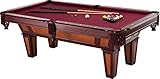

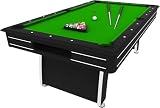
Choose slate if…
- You play weekly, practice for a league, or want the table to feel like a real billiard hall table.
- The table is going in a basement or ground-floor room and will stay put for years.
- Your room has any humidity swings (basements, lake houses).
- You want a lifetime warranty and professional installation.
- You see the table as long-term furniture rather than a toy.
Choose MDF if…
- You play casually, a few times a month, with family or friends.
- Your budget is under about $1,500 for the table.
- The table is going upstairs, or you rent and may move soon.
- You want to assemble it yourself this weekend.
- You need a folding or compact table; see our 7 ft and small pool tables.
Choose a hybrid if…
- You want something firmer and longer-lasting than basic MDF without slate's weight or installation.
- A long surface warranty matters to you (GLD's 7-year Accuslate warranty is the standout).
- You accept that it's still not stone, whatever the name suggests.
What about the cloth?
Bed material and cloth are separate decisions, but they interact. A slate bed lets you get the most from a quality worsted wool cloth, which the WPA recommends at 80 to 85% worsted wool and 15 to 20% nylon for serious play. On an MDF table, a premium cloth still feels faster and smoother, but it can't hide dips in the bed. If you're on a budget, put the money into the bed first; you can always replace the cloth later, and the bed is the part you can't upgrade.
How to tell slate from MDF on a used table
- Look underneath. Slate shows gray stone edges resting on the frame. MDF looks like brown fiberboard.
- Count the seams. Slate beds usually have two seams (three pieces), sometimes visible as faint lines under the cloth. MDF is usually one piece.
- Knock through the cloth. Slate sounds dull and solid; MDF sounds hollower.
- Ask about weight. Slate tables usually weigh several hundred pounds more than MDF tables of the same size, so a surprisingly light table is a red flag.
- Check the listing name. "Slatron", "Accuslate" and "Slate-Tech" are not slate.
FAQ
Is a slate pool table worth it?
Yes, if you play regularly or want a table that lasts decades. Slate stays flat and doesn't react to humidity, so the roll stays true for the life of the table. If you play a few times a month, have a tight budget, or may move house soon, a good 3/4-inch MDF table is the more sensible buy.
How can you tell if a pool table has slate?
Look under the table: slate shows gray stone edges resting on the frame, while MDF looks like brown fiberboard. Knock on the bed through the cloth; slate sounds solid and dull. Weight is the giveaway too, since slate tables usually weigh several hundred pounds more than MDF tables of the same size.
How thick should pool table slate be?
One inch is the WPA tournament minimum and the norm on quality home tables, typically in three matched pieces on a wood frame at least 3/4 inch thick. Some home tables use 3/4-inch slate with a wood backing, which is acceptable but not as good.
Is Accuslate or Slatron real slate?
No. Accuslate (GLD Products) and Slatron (Mizerak) are slate alternatives, not stone. They're engineered surfaces that cost less and weigh much less. GLD backs its Accuslate surface with a 7-year warranty, which is a good sign, but neither plays exactly like slate over the long term.
Can you move a slate pool table yourself?
You shouldn't. The slate has to be unscrewed, separated, re-shimmed, re-seamed and re-leveled, and the cloth usually needs replacing. Professional movers or billiard techs handle this. College Hunks Hauling Junk puts local pool table moves at $375 to $1,500 (July 2026).
Bottom line
If you'll play often and the table will stay put, buy slate: our best pool tables guide covers the top slate picks, led by the Brunswick Black Wolf Pro. For casual play and tighter budgets, a 3/4-inch MDF or Accuslate table is the smart buy. Whichever you choose, the cloth will wear before the bed does; see our pool table felt guide when it's time to replace it, and check sizes in our pool table dimensions guide.