We research products independently. When you buy through links on this page, we may earn a commission from Amazon at no extra cost to you. As an Amazon Associate we earn from qualifying purchases. Read our affiliate disclosure.
Pool table felt is the part of your table that wears out, and it's the cheapest way to make an old table play like new. The cloth controls how fast the balls roll, how much they react to spin, and how true they run on slow shots near the pocket. Choosing well means deciding between two very different families of cloth, woolen and worsted, and then matching the blend and weight to how you play.
This guide covers both decisions with real cloths from Simonis, Championship and Brunswick. Then it walks you through a full replacement, using the World Pool-Billiard Association's (WPA) cloth-fastening guidelines as the standard for tension and stapling.
One note on words: "felt" is what most people call it, but the industry calls it billiard cloth. Real felt is a pressed, non-woven fabric, and no decent table uses it.
Our top picks at a glance


Quick picks
- Best Tournament Cloth: Simonis 860Best for players who want the cloth used at major pool events.
- Best Value Worsted: Championship Tour EditionBest for fast, durable worsted play at a lower tier than Simonis.
- Best for Heavy Use: Simonis 760Best for high-traffic tables and league practice.
- Best Spill Resistance: Brunswick Centennial Stain-ResistantBest for family rooms where drinks meet cloth.
- Best for Most Home Tables: Championship Invitational TeflonBest for casual play, with 26 colors.
- Best Lightweight Worsted: Simonis 920Best for home tables that want worsted speed in a lighter cloth.
- Best Budget: Championship Valley Teflon UltraBest for a basic recover on a tight budget.
- Best Cloth + Cover Kit: KONLLEN 9 ft Cloth and Cover SetBest for a 9 ft recover that comes with a dust cover.
Comparison table
| Cloth | Best for | Type | Blend (wool/nylon) | Weight | Amazon |
|---|---|---|---|---|---|
| Simonis 860 | Tournament play | Worsted | 90/10 | About 410 g/m² | Check price |
| Championship Tour Edition | Value worsted | Worsted | 70/30 | 24 oz | Check price |
| Simonis 760 | Heavy use | Worsted | 70/30 | About 355 g/m² | Check price |
| Brunswick Centennial | Spill resistance | Merino wool with Teflon | 100% Merino wool | 23 oz per linear yard | Check price |
| Championship Invitational Teflon | Most home tables | Woolen, Teflon-treated | 75/25 | 20 oz | Check price |
| Simonis 920 | Lightweight worsted | Worsted | 85/15 | About 330 g/m² | Check price |
| Championship Valley Teflon Ultra | Budget | Woolen, Teflon-treated | 75/25 | 19 oz | Check price |
| KONLLEN 9 ft Cloth and Cover Set | 9 ft recover plus cover | Not stated | 80/20 | Not published | Check price |




Simonis lists weight in grams per square meter; Championship and Brunswick list ounces. The two aren't directly comparable, so compare within each brand.
The best pool table felts, reviewed
1. Simonis 860: Best Tournament Cloth
Who it's for: serious players and anyone who wants the cloth pros practice on.
Iwan Simonis is the Belgian mill whose name is close to shorthand for tournament cloth, and the 860 is its pool flagship. Simonis says it's chosen for virtually all major pool tournaments and championships worldwide. It's a worsted cloth of 90% wool and 10% nylon at about 410 g/m², woven in 165 and 198 cm widths. Worsted construction gives the fast, flat, consistent roll you see on TV, and the tight weave doesn't pill.
If you want slightly more durability, Simonis also makes the 860 HR at the same weight, with a 70/30 blend it describes as the best balance of ball control and speed.
Pros
- The reference tournament cloth
- Fast, consistent worsted roll
- High wool content for a smooth surface
- 860 HR version for extra durability
Cons
- Premium price tier
- Fast cloth exposes a table that isn't level
- No stain treatment, so spills need quick action
2. Championship Tour Edition: Best Value Worsted
Who it's for: home players who want worsted speed without paying Simonis prices.
Championship is the US cloth brand many dealers, including Brunswick, stock. Tour Edition is its worsted cloth: 24 oz, 70% wool and 30% nylon, and Brunswick's dealer listing calls it the fastest, most durable tournament cloth in the industry. The 70/30 blend gives up a little silkiness for wear resistance, which suits a home table that gets a lot of play. Brunswick lists 13 colors, cut for 7, 8 and 9 ft tables.
Pros
- True worsted construction
- Durable 70/30 blend
- 13 colors in 7, 8 and 9 ft cuts
- Sold through billiard dealers
Cons
- Not Teflon-treated
- Brunswick notes a 7 to 8 day lead time on Championship orders
- Faster than many casual players expect
3. Simonis 760: Best for Heavy Use
Who it's for: tables that get played every day, from busy family basements to league practice rooms.
Simonis recommends the 760 especially for high-traffic tables. It's 70% wool and 30% nylon at about 355 g/m², and comes in 165, 195 and 206 cm widths. The extra nylon is the point: it holds up better at the break area and along the head string, where cloth wears first. It still plays like worsted, just a touch less silky than the 860.
Pros
- Built for high traffic
- Worsted speed with more nylon for durability
- Three widths
- Strong value for a Simonis cloth
Cons
- Lighter than the 860
- Premium tier compared with woolen cloths
- No stain treatment
4. Brunswick Centennial Stain-Resistant Billiard Cloth: Best Spill Resistance
Who it's for: family rooms and home bars, where drinks end up on the table sooner or later.
Brunswick's Centennial cloth is 100% Merino wool with an embedded Teflon fabric protector, at 23 oz per linear yard. Brunswick says it lasts up to 60% longer than competitors and that the protection doesn't compromise playability, thanks to a five-step finishing process. It's offered in 14 colors, from Brunswick Green to Ebony, in standard and 9 ft sizes.
Brunswick also sells a Traditional Woolen Cloth, a 75/25 wool-nylon blend at 21 oz, if you want the Brunswick name at a lower tier.
Pros
- Teflon protector for spill resistance
- Heavy 23 oz Merino wool
- 14 colors
- From a major table maker, sized for its tables
Cons
- The "up to 60% longer" claim is Brunswick's own
- Not sold as a worsted tournament cloth
- Sized around Brunswick's standard and 9 ft tables

Brunswick Centennial Stain-Resistant Billiard Cloth
by Brunswick
5. Championship Invitational Teflon: Best for Most Home Tables
Who it's for: casual players, families and anyone recovering an MDF or entry-level slate table.
Invitational is the woolen cloth you'll find on a huge number of home tables. It's 20 oz, 75% wool and 25% nylon, treated with Teflon for water and stain resistance. It comes in 26 colors, from classic Championship Green to Titanium and Wine. Imperial sells it pre-cut for an 8 ft table at 54 x 100 inches for the bed plus six rail cuts, which shows what a table kit includes.
As a woolen cloth it plays slower and grips spin more than worsted, which many casual players prefer. Expect some pilling as it ages.
Pros
- Teflon treatment for spills
- 26 colors
- Sold pre-cut for 7, 8 and 9 ft tables
- Slower, forgiving speed suits casual play
Cons
- Woolen cloth pills over time
- Slower than worsted
- Not suited to serious practice
Championship Invitational Teflon Pool Table Cloth
by Championship
6. Simonis 920: Best Lightweight Worsted
Who it's for: home owners who want worsted's speed and smoothness in a lighter, all-purpose cloth.
Simonis describes the 920 as a lighter all-purpose cloth for home pool and carom tables and billiard rooms. It's 85% wool and 15% nylon at about 330 g/m², in 166 and 195 cm widths. That blend sits inside the WPA's recommended 80 to 85% wool range, and the lighter weight makes it a sensible upgrade from woolen cloth on a home table.
Pros
- Worsted construction
- 85/15 blend within the WPA's recommended range
- Positioned by Simonis for home tables
- Smoother and faster than woolen cloth
Cons
- Lighter than the 860 and 760
- Less widely stocked than the 860
- No stain treatment

7. Championship Valley Teflon Ultra: Best Budget
Who it's for: a basic recover on a budget table or a rec-room table that just needs fresh cloth.
Valley Teflon Ultra is a woolen cloth at 19 oz, 75% wool and 25% nylon, treated with Teflon for water and stain resistance. It's lighter than Invitational and comes in seven colors, including Championship Green, Electric Blue, Navy, Burgundy, Steel Gray, Black and Championship Blue, in 7, 8 and 9 ft cuts. It won't play like worsted, but it's a big step up from worn-out factory cloth.
Pros
- Low price tier
- Teflon-treated
- Seven colors in three table sizes
- Easy to work with for a first DIY recover
Cons
- Lightest cloth here, at 19 oz
- Woolen, so slower and prone to pilling
- Fewer color options

8. KONLLEN 9 ft Pool Table Cloth and Cover Set: Best Cloth + Cover Kit
Who it's for: owners of a standard 9 ft table who want new cloth and a dust cover in one order.
KONLLEN's set includes a bed cloth, six matching rail cloths and a waterproof, dustproof table cover, sized for most standard 9 ft tables. The cloth is an 80% wool and 20% nylon blend, a ratio that sits within the WPA's 80 to 85% wool range on paper. The listing doesn't say whether the cloth is woolen or worsted, and it doesn't publish a weight, so you can't compare it directly with the Simonis or Championship figures above. KONLLEN is better known for carbon-fiber cues, and this set is a newer listing than the established cloth lines here.
The included cover is the practical bonus. A cover keeps dust, pet hair and spills off fresh cloth, which is the single easiest way to make a recover last. Check the cut against your table's playing surface before ordering, because it's only offered for 9 ft tables.
Pros
- Bed cloth, six rail cloths and a cover in one set
- 80/20 wool-nylon blend
- Waterproof, dustproof cover included
- Simple choice for a 9 ft home recover
Cons
- 9 ft only
- Weight and woolen/worsted construction not published
- Newer cloth line with a short track record
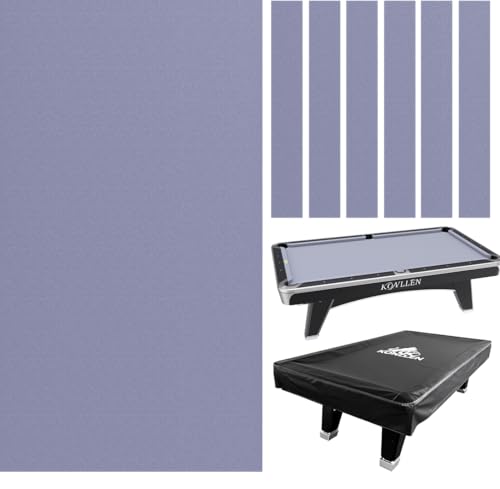
If you already own a good cover, KONLLEN also sells a replacement cloth set for 9 ft tables, in gray; the listing offers the cover as an option.
Pool table felt buying guide
Woolen vs worsted: the big decision
- Worsted cloth (Simonis 860, 760, 920; Championship Tour Edition) is woven from long, combed fibers into a tight, flat weave with no nap. It plays fast, rolls true, doesn't pill, and lasts longer. It's what the WPA specifies for competition.
- Woolen cloth (Championship Invitational, Valley Teflon Ultra) uses shorter fibers with a slight nap. It's slower, more forgiving, cheaper, and often Teflon-treated, but it wears and pills sooner.
If you practice for leagues or tournaments, buy worsted. If the table is mainly for family and friends, woolen is fine.
Blend and weight
Wool gives smoothness and speed; nylon gives strength. Worsted cloths in this guide run from 70/30 (more durable) to 90/10 (silkier). The WPA's Recommended Equipment Specifications call for non-directional, nap-free cloth of 80 to 85% combed worsted wool and 15 to 20% nylon, with 100% worsted wool preferred and no backed cloth allowed. Heavier cloth within a brand generally wears longer.
Color
Color is mostly personal, but it affects visibility. For competition, the WPA allows only yellow-green, blue-green or electric blue. At home, anything goes. Darker colors like black and charcoal show chalk and lint, while blues and greens hide them. Under warm light, tan and camel can look washed out; see our pool table light guide for color temperature tips.
Size: buy a table kit
Cloth is sold by the table: one bed piece plus six rail strips, cut for 7, 8 or 9 ft. Imperial's 8 ft Invitational kit, for example, is a 54 x 100 inch bed piece plus 6 rail cuts. Check your table's playing surface in our pool table dimensions guide, since a pro 8 ft (92 x 46 inch surface) needs more cloth than a home 8 ft (88 x 44 inch surface).
Bed material matters
Premium worsted cloth shows off a flat slate bed. It also shows up every dip in a worn MDF bed. If your table is MDF, a mid-weight woolen or the Simonis 920 makes more sense than the 860. Our slate vs MDF guide explains why.
How to replace pool table felt
Recovering a table is a one-day job for a patient DIYer, or a quick visit for a billiard technician. The steps below are for a typical slate table with a wood backing (liner) under the slate. The tension and stapling figures come from the WPA's cloth-fastening guidelines. On MDF tables and unbacked slate, cloth is often glued rather than stapled. Check your table's manual before you start.
Tools
- Socket wrench set (for rail bolts)
- Staple gun and staples, or a tack hammer
- Staple puller and flat screwdriver
- Sharp utility knife with fresh blades
- Soft brush, vacuum and lint-free cloth
- Spray adhesive (for pocket cuts on glued tables)
- A helper
Steps
- Remove the pockets and rails. Take off drop-pocket hardware, then remove the rail bolts from under the table and lift the rails off. Keep the bolts for each rail together.
- Strip the old bed cloth. Pull the staples or tacks from the slate liner and peel the cloth off. Remove any old glue at the pocket cuts.
- Clean and inspect the bed. Vacuum the slate, then check the seams between slate pieces. If the beeswax filler is cracked or a seam is proud, fix it now. This is also the moment to check level.
- Lay the new cloth. Find the cloth's face side (smoother, often marked on the selvage) and position it with even overhang on all sides.
- Stretch the length. The WPA guideline is to stretch the cloth's length as tight as you can by hand, then relieve it by 1/2 inch before fastening.
- Stretch the width. Stretch the width as tight as possible by hand, then relieve it by 1/4 inch before fastening.
- Fasten the bed cloth. Work from the middle of each side outward. The WPA calls for staples or tacks spaced at most about 1 inch apart, driven at least 3/8 inch into the wooden slate liner.
- Cut the pockets. Cut and fold the cloth into each pocket opening. Per the WPA, a strip of canvas or cloth should be glued to the vertical pocket cuts first, and no folds are allowed in the cloth over the corner pocket facings.
- Recover the rails. Remove each rail's feather strip, lay the rail cloth over the cushion, stretch it lengthwise evenly and insert the feather strip. Then stretch it across the cushion until the nose of the rubber is just about to dent, and staple it underneath. The WPA calls for staples about 3/4 inch apart with at least 3/8 inch penetration.
- Reinstall rails and pockets. Bolt the rails back on, torqued evenly, and refit the pockets. Brush the cloth and roll a few balls to check the speed and bounce.
Common mistakes
- Too loose: wrinkles and balls that "drag" or roll off line. Too tight, and the cloth can tear at the pocket cuts.
- Working from one corner: always fasten from the center of each side outward, alternating sides.
- Uneven rail tension: the cushions play differently from rail to rail.
- Skipping the bed check: new cloth on an unlevel bed still rolls off.
- Wrong side up: worsted cloth has a face side; installed backward, it plays differently.
Make the new cloth last
Brush toward the pockets with a soft horsehair brush or use a brushless vacuum; the WPA recommends both and warns against brushes that shed bristles. Keep the balls clean so they don't drag dirt across the cloth, and cover the table when it isn't in use. Our guide to how to clean pool table felt has the full routine. Our pool table cover guide and accessories guide cover both.
How we chose
We compared cloths from the three sources most US players buy from: Iwan Simonis, Championship, and Brunswick's own line, plus one newer cloth-and-cover kit from KONLLEN sold on Amazon. We used the makers' and authorized dealers' published blend, weight and width figures (Brunswick and Imperial list the Championship specs we cite, and KONLLEN's Amazon listing supplies its blend and contents). We didn't test these cloths. Our replacement steps follow the WPA's Recommended Equipment Specifications for cloth fastening; for your table's specific hardware, follow its manual.
FAQ
What is the best pool table felt?
For serious play, a worsted cloth such as Simonis 860 or Championship Tour Edition. Worsted cloth is fast, smooth and doesn't pill. For a family table, a Teflon-treated woolen cloth like Championship Invitational is the practical choice: slower, more forgiving and better with spills.
What is pool table felt made of?
Billiard cloth is a blend of wool and nylon. Woolen cloths like Championship Invitational are 75% wool and 25% nylon. Worsted cloths range from Simonis 760 at 70/30 to Simonis 860 at 90/10. For tournaments, the WPA specifies 80 to 85% combed worsted wool with 15 to 20% nylon, and prefers 100% worsted wool.
How often should pool table felt be replaced?
There's no fixed schedule. Replace it when you see bald spots or thin areas (often at the break spot and the head string), tears, pilling that slows the balls, or stains you can't remove. A home table played a few times a week can often go many years; a heavily used table much less.
Can I replace pool table felt myself?
Yes, if you're handy and patient. You'll remove the rails, pull the old staples, stretch the new cloth over the bed and staple it, then recover each rail. Getting the tension right is the hard part. On a slate table, many owners hire an installer so the slate can be re-leveled at the same time.
What's the difference between worsted and woolen cloth?
Worsted cloth is woven from long, combed wool fibers into a tight, flat weave, so it plays fast and doesn't pill. Woolen cloth uses shorter fibers with a slight nap, so it plays slower, wears faster and pills over time, but it's cheaper and more forgiving.
How much felt do I need for an 8 ft pool table?
Buy cloth cut for your table size, which includes the bed piece and six rail strips. Imperial lists its 8 ft Championship Invitational cut at 54 x 100 inches for the bed plus 6 rail cuts. For a 9 ft or pro 8 ft table, order the larger cut.
Verdict
If you play seriously, recover with worsted cloth: Simonis 860 if you want the tournament standard, or Championship Tour Edition for fast, durable play at a lower tier. For family tables, Championship Invitational Teflon or Brunswick Centennial handle spills and casual play best. Whichever you choose, the WPA's tension and stapling guidelines are the difference between a pro-feeling recover and a wrinkled one. If you're pricing a recover against a new table, see our pool table cost guide.