We research products independently. When you buy through links on this page, we may earn a commission from Amazon at no extra cost to you. As an Amazon Associate we earn from qualifying purchases. Read our affiliate disclosure.
Pool table dimensions are measured by the playing surface, the cloth inside the cushions. A regulation 9 ft table is 100 x 50 inches, a pro 8 ft is 92 x 46 inches, a typical home 8 ft is 88 x 44 inches, and a 7 ft is about 76 x 38 to 78 x 39 inches. Every standard size keeps a 2:1 length-to-width ratio. The outside of the table adds roughly 6 to 7 inches of rail on every side.
Below: the full size chart, the official WPA measurements, overall footprints of real tables, heights, pocket sizes and how to measure the table you already own.
Pool table sizes at a glance
Pool table dimensions and sizes chart
| Nominal size | Playing surface | Typical overall size | Room needed (58" cues) | Who it suits | Amazon |
|---|---|---|---|---|---|
| 6 ft | About 66" x 33" | 76" x 43.25" (Hathaway Fairmont) | 15'2" x 12'5" | Kids, apartments, folding tables | See options |
| 7 ft | 76" x 38" to 78" x 39" | 89.25" x 51.25" (Brunswick Black Wolf Pro 7') | 16'2" x 12'11" | Small game rooms, bar-style play | See options |
| 8 ft (home) | 88" x 44" | 98.5" x 54.5" (Brunswick Brae Loch) to 100" x 56" (Hathaway Hustler) | 17'0" x 13'4" | Most homes | See options |
| 8 ft (pro / WPA) | 92" x 46" | Varies by maker | 17'4" x 13'6" | Serious players with space | |
| 9 ft (regulation) | 100" x 50" | 113.25" x 63.25" (Black Wolf Pro 9') to 114.6" x 64.8" (Gold Crown VI) | 18'0" x 13'10" | Tournament practice, large rooms | See options |
The room figures assume standard 58-inch cues: playing surface plus two cue lengths each way. Try different cue lengths in our pool table room size calculator.
Quick answers in 60 seconds
Regulation pool table size (WPA specs)
The World Pool-Billiard Association publishes the equipment specifications used for tournament play. The key numbers:
| Spec | WPA requirement |
|---|---|
| 9 ft playing surface | 100" x 50" (±1/8") |
| 8 ft playing surface | 92" x 46" (±1/8") |
| Bed height (floor to playing surface) | 29.25" to 31" |
| Slate | At least 1" thick; tournament tables use three equal pieces on a wood frame at least 3/4" thick |
| Corner pocket mouth | 4.5" to 4.625" |
| Side pocket mouth | 5" to 5.125" |
| Cloth | 80–85% worsted wool / 15–20% nylon recommended |
Two important caveats. First, the WPA doesn't define a 7 ft size. Second, the WPA itself notes that these specs don't necessarily apply to tables made for home use. That's why a home "8 ft" table is usually 88 x 44 inches, not 92 x 46.
7 vs 8 vs 9 ft: what changes when you play
9 ft: the tournament standard
A 9 ft table's 100 x 50 inch surface is the size used in professional and most serious amateur play. Shots are longer, position play matters more, and cut shots that are easy on a small table get harder. Tables like the Brunswick Gold Crown VI Tournament are built to this spec, including the tighter WPA pocket cuts.
8 ft: the home standard
The 8 ft table is what most people mean by a standard pool table size for a home. It fits rooms of about 17 x 13 ft and plays close enough to a 9 ft table that skills transfer well. Watch for which 8 ft you're buying: home 88 x 44 or pro 92 x 46. Some value tables go smaller still, like the Barrington Slate-Tech's 84 x 42 inch surface.
7 ft: compact and bar-style
Seven-foot tables trade length for fit: the surface is 10 to 12 inches shorter than a home 8 ft. Balls are closer to pockets, so the game is faster and more forgiving, which suits casual and family play. Our guide to 7 ft pool tables covers the best compact picks.
6 ft and smaller
Six-foot tables (about 66 x 33 inch surfaces) are mostly folding or kids' tables. They usually come with shorter cues, often 48 inches, and larger pockets relative to the table. They're fun, but they won't build skills for a full-size table.
Overall dimensions: why rails and style matter
Two tables with identical playing surfaces can differ by several inches outside, depending on rail width and styling. Brunswick's Black Wolf Pro adds about 6.6 inches per side around its playing surface. Here are real overall footprints from makers' spec sheets:
| Table | Nominal | Overall (L x W) | Height | Amazon |
|---|---|---|---|---|
| Brunswick Black Wolf Pro | 7 ft | 89.25" x 51.25" | 32" rail | |
| Brunswick Black Wolf Pro | 8 ft | 101.25" x 57.25" | 32" rail | |
| Brunswick Black Wolf Pro | 9 ft | 113.25" x 63.25" | 32" rail | |
| Brunswick Brae Loch | 8 ft | 98.5" x 54.5" | 32" | |
| Brunswick Gold Crown VI Tournament | 9 ft | 114.6" x 64.8" | 32.3" | Check price |
| Hathaway Hustler | 8 ft | 100" x 56" | 31.5" | See options |
| Fat Cat Reno | 7.5 ft | 89.5" x 50.5" | 31" | Check price |

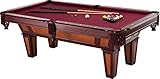
Overall size matters for delivery, doorways and walkways, but it does not change how much room you need to play. That's driven by the playing surface and cue length.
Pool table height, pockets and balls
- Height: WPA puts the bed 29.25 to 31 inches off the floor. Home tables typically have a rail height around 31 to 32 inches.
- Pockets: Tournament corners are 4.5 to 4.625 inches and sides 5 to 5.125 inches. Home tables are often more forgiving; Brunswick's Black Wolf Pro and Brae Loch use 5-inch corners and 5.5-inch sides.
- Balls: Full-size tables use standard 2¼-inch balls, which is what tables like the Fat Cat Reno and Hathaway Hustler ship with. Small and folding tables sometimes come with smaller balls, so check before buying replacements.
- Slate: 1 inch is the WPA minimum and the norm on quality home tables. Some home tables use 3/4-inch backed slate.
Size also drives weight. Brunswick's shipping weights run from 605 lb for a 7 ft Black Wolf Pro to 1,019 lb for the 9 ft gully-return version. See how much a pool table weighs for more.
How to measure a pool table
Measuring an existing table, or checking a used listing? Do it this way:
- Measure the playing surface, not the frame. Run the tape from the nose of one cushion (the point of the rubber that the ball touches) to the nose of the opposite cushion, along the length.
- Repeat across the width. Measure from the side cushion nose to the opposite side cushion nose.
- Check the ratio. Length should be about twice the width. If it is, you have a standard table.
- Match it to the chart. About 100 x 50 inches is a 9 ft, 92 x 46 is a pro 8, 88 x 44 is a home 8, and 76 to 78 by 38 to 39 is a 7 ft.
- Measure the outside dimensions separately. Measure rail to rail at the widest point, including any flared legs or pockets, for moving and placement.
- Measure the height. Measure from the floor to the top of the rail, and to the cloth, to check against the WPA's 29.25 to 31 inch bed height.
- Check the bed material. Look underneath the table. Slate shows as gray stone edges resting on the frame, while MDF looks like brown fiberboard. A slate bed adds hundreds of pounds, which matters if you plan to move it.
Common mistakes
- Treating "8 ft" as one size. Home 8 ft (88 x 44) and pro 8 ft (92 x 46) differ by 4 x 2 inches.
- Measuring rail to rail and calling it the playing surface. You'll overestimate by about a foot in each direction.
- Planning a room from the overall dimensions. Room size depends on the playing surface plus cue length.
- Buying cloth or covers by nominal size alone. Covers fit the outside dimensions, and cloth must fit the bed and rails. Measure both.
- Assuming all 7 ft tables are the same. Surfaces range from about 76 x 38 to 78 x 39 inches.
FAQ
What is the standard pool table size for a home?
The most common home size is the 8 ft table, which usually has an 88 x 44 inch playing surface. In small rooms, 7 ft tables (about 76 to 78 inches by 38 to 39 inches) are the common alternative. Both are smaller than the 9 ft tournament table.
What are regulation pool table dimensions?
Under WPA (World Pool-Billiard Association) specifications, a 9 ft table has a 100 x 50 inch playing surface (plus or minus 1/8 inch), and an 8 ft table has 92 x 46 inches. The bed must sit 29.25 to 31 inches above the floor, and tournament tables use slate at least 1 inch thick.
How big is a 7 foot pool table?
A 7 ft table typically has a playing surface of about 76 x 38 to 78 x 39 inches. Overall size depends on the rails: Brunswick's 7 ft Black Wolf Pro is 89.25 x 51.25 inches outside, with a 32-inch rail height.
Is there a 2:1 ratio for pool tables?
Yes. Standard pool tables have a playing surface twice as long as it is wide: 100 x 50, 92 x 46, 88 x 44 and 78 x 39 inches all follow the 2:1 rule. That ratio is what makes diamond-system bank shots work consistently across sizes.
How tall is a pool table?
WPA specs put the playing bed 29.25 to 31 inches above the floor. Rail height on home tables is typically around 32 inches. Brunswick lists 32 inches for the Black Wolf Pro and Brae Loch, for example.
Find the right table for your size
Once you know which size your room can take, compare slate and MDF options in our best pool tables for home guide. For what the rail markers measure, see our guide to pool table diamonds. If you're wondering how pool tables compare with snooker and carom billiards tables, which use different sizes entirely, see billiards vs pool.