We research products independently. When you buy through links on this page, we may earn a commission from Amazon at no extra cost to you. As an Amazon Associate we earn from qualifying purchases. Read our affiliate disclosure.
The paddle is the one piece of table tennis gear you touch on every shot, and the box it comes in tells you surprisingly little. "Pro" and "tournament" are printed on paddles that would hold back a decent club player, while some of the best ping pong paddles for learning look plain and cost very little.
What matters is a short list: how fast the blade is, how grippy the rubber is, how thick the sponge is, and whether the handle fits your hand. Get the balance right for your level and you'll improve faster. Get it wrong (usually by buying too fast a paddle too early) and the ball keeps sailing off the end of the table.
Below are four paddles that cover the realistic range for home players, from a family set to carbon rackets. If you're still choosing a table, start with our best ping pong tables guide.
Our top picks at a glance


Quick picks
- Best Overall: STIGA Pro CarbonBest for improving players who want speed and spin from a carbon blade.
- Best for Spin and Control: JOOLA Infinity OverdriveBest for attacking players who still want a forgiving, high-control racket.
- Best Step-Up Paddle: STIGA TitanBest for players moving on from basic paddles who need more spin without carbon speed.
- Best Family Set: STIGA Performance 4 Player SetBest for families and game rooms that need four matching paddles and balls.
Comparison table
| Paddle | Best for | Blade | Rubber / sponge | Maker's ratings (speed / spin / control) | Amazon |
|---|---|---|---|---|---|
| STIGA Pro Carbon | Improving players | Integrated carbon fiber | Inverted rubber with STIGA's Nano Composite and ACS tech | 99 / 100 / 80 | Check price |
| JOOLA Infinity Overdrive | Spin with control | 7-ply, 6.1 mm (5 wood + 2 KL-C carbon) | JOOLA Micron 48, smooth inverted | 100 / 99 / 92 | Check price |
| STIGA Titan | Step-up | Ultra-light balsa, 5-ply (listing) | ITTF-approved smooth inverted; 2 mm sponge (listing) | 80 / 77 / 81 | See options |
| STIGA Performance 4 Player Set | Families | 5-ply wood, flared handle | Smooth inverted, 1.5 mm sponge | 38 / 39 / 53 | Check price |



Ratings are each maker's own 0 to 100 scale, so compare them within a brand, not across brands.
The best ping pong paddles, reviewed
1. STIGA Pro Carbon: Best Overall
Who it's for: players who can already rally and want a faster, spinnier paddle for basement or garage matches.
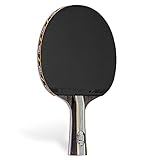
The Pro Carbon is the paddle that most home players graduate to, and STIGA builds it as a competition racket. STIGA says the blade has integrated carbon fiber and is hardened with its Crystal Technology for speed, while its WRB Technology is meant to improve balance and feel. The rubber uses STIGA's Nano Composite and ACS technologies, which STIGA describes as giving high speed and elasticity while keeping control.
On STIGA's own scale it rates 99 for speed, 100 for spin and 80 for control. In plain terms, it's fast and grabs the ball well, but it gives back less margin than a beginner paddle. That's the right trade once your strokes are repeatable. If you still mishit a lot, start with the Titan below and move up later.
Pros
- Carbon blade gives a big jump in speed over wood-only paddles
- Top spin rating on STIGA's scale
- Widely sold and easy to replace
Cons
- Lower control rating than the JOOLA Infinity Overdrive
- Too fast for true beginners
- STIGA's page doesn't publish sponge thickness or weight
2. JOOLA Infinity Overdrive: Best for Spin and Control
Who it's for: attacking players who want carbon speed but still need a racket that forgives the odd off-center hit.
JOOLA publishes more construction detail than most pre-made paddles, which makes the Infinity Overdrive easy to judge. The blade is 7-ply and 6.1 mm thick: five plies of real wood (Hinoki, Koto and Ayous, according to JOOLA) plus two plies of KL-C carbon, which JOOLA says adds speed and enlarges the sweet spot. Both sides use JOOLA's Micron 48 rubber, a smooth, inverted rubber with a tacky surface for spin.
JOOLA rates it 100 for speed, 99 for spin and 92 for control. Remember that's JOOLA's scale, not STIGA's, so don't read it as "better than the Pro Carbon." What the numbers do tell you is how JOOLA positions it in its own range: a fast paddle that keeps control high. The flared handle is the most common shape and suits most players.
Pros
- Detailed, published blade construction
- Tacky Micron 48 rubber for spin on loops and serves
- High control rating within JOOLA's range
- Comfortable flared handle
Cons
- Fast for new players, like any carbon paddle
- Ratings can't be compared directly with STIGA's
- Color options are limited (red or yellow, per JOOLA)

JOOLA Infinity Overdrive Table Tennis Racket
by JOOLA
3. STIGA Titan: Best Step-Up Paddle
Who it's for: players who've outgrown a basic family paddle but aren't ready for carbon.
The Titan is a sensible middle ground. STIGA builds it around an ultra-light balsa blade with ITTF-approved smooth inverted rubber, plus the same Crystal and WRB blade technologies used on its faster rackets. The Amazon listing describes a 5-ply blade, a 2 mm sponge and a flared handle.
STIGA rates it 80 for speed, 77 for spin and 81 for control. Control is the highest of the three, which is exactly what you want while you're learning topspin and blocking. It's also a good "second paddle" for a guest who keeps borrowing yours.
Pros
- Control-first balance for learning real strokes
- ITTF-approved rubber
- Light balsa blade is easy on the arm
- Clear upgrade over recreational paddles
Cons
- Slower than carbon rackets, so advanced hitters will want more
- Blade ply and sponge figures come from the retail listing rather than STIGA's page

STIGA Titan Performance Ping Pong Paddle
by STIGA
Currently unavailable on Amazon
4. STIGA Performance 4 Player Set: Best Family Set
Who it's for: families, game rooms and offices that need four decent paddles at once.
Most cheap paddle sets come with pimpled rubber that's slippery and offers little spin. STIGA's Performance set uses smooth inverted rubber instead, on 5-ply blades with solid wood flared handles and a 1.5 mm sponge. You get four paddles and six 3-star, 40 mm regulation balls (three orange, three white), and STIGA says the set is USATT approved. Each paddle has one red face and one black face, like tournament rackets.
STIGA's ratings (38 speed, 39 spin, 53 control) make the point: these are control paddles. That's right for kids, casual doubles and anyone who mostly wants long rallies.
Pros
- Four paddles plus six 3-star balls
- Smooth inverted rubber, not slippery pips
- USATT approved, per STIGA
- Control-focused for new players
Cons
- Regular players will outgrow them
- No case included in STIGA's description
- Low spin compared with single performance paddles
How to choose a ping pong paddle
Speed, spin and control ratings
Most brands print three numbers on the box. Speed is how hard the ball leaves the paddle, spin is how much the rubber grabs it, and control is how forgiving the paddle feels. They're useful within one brand's lineup: STIGA's Titan (80/77/81) is clearly a calmer paddle than its Pro Carbon (99/100/80). They're not useful across brands, because every maker uses its own scale and test method.
A simple rule for home players: if control is much lower than speed, the paddle is for someone with consistent strokes. If control is the highest number, it's a learning paddle.
Blade: wood, carbon and ply count
The blade does most of the work on speed. All-wood blades (often 5-ply) are slower and give more feel. Carbon or other composite layers stiffen the blade, so the ball comes off faster and the sweet spot grows. JOOLA's Infinity Overdrive, for example, pairs five wood plies with two carbon plies in a 6.1 mm blade.
More plies and more carbon generally mean more speed. That's great for finishing points and hard to control when you're still learning.
Rubber: inverted vs pimpled
Smooth, inverted rubber (pimples facing in) is the default for good reason: it creates the most spin and is the most versatile. Short pimples-out rubber is less sensitive to spin and is found on some cheap paddles and a few specialist rackets. For home play, choose inverted rubber on both sides. All four picks here use it.
Tackiness matters too. JOOLA describes its Micron 48 as tacky, which helps on serves and slow, spinny loops.
Sponge thickness
The sponge sits under the rubber. Thinner sponges (around 1.5 mm, as on STIGA's Performance set) feel controlled and slower. Thicker sponges (2 mm, as listed for the Titan) add speed and spin but feel livelier. Under ITTF rules, the total thickness of sponge-backed rubber, including adhesive, can't exceed 4 mm per side, so even "max" sponges have a ceiling.
Handle shape
Flared handles widen at the bottom and stop the paddle sliding out of your hand. That's why they're the most common choice and the default on every pick here. Straight handles make it easier to switch grips between forehand and backhand. Anatomic handles bulge in the middle. If you're unsure, start with flared.
Approval marks: ITTF and USATT
An ITTF-approved rubber means that rubber is legal in sanctioned tournaments. It doesn't make a paddle "pro." It just means you could play a league match with it. For tournament play, the ITTF also requires the two faces to be different colors, one of them black. Our ping pong rules guide covers what changes between house games and official play.
Sets vs single paddles
Sets are the practical choice for families and game rooms: everyone gets a matching paddle and you get balls in the box. The trade-off is that set paddles are built for control, not speed or spin. Single performance paddles cost more per paddle but play noticeably better. A common approach is to buy one good single paddle for the most serious player in the house and a set for everyone else.
Balls matter too
Paddles get the attention, but balls change how a game feels. Regulation balls are 40 mm. Three-star balls, like those in STIGA's Performance set, are the higher grade and bounce more consistently than 1-star training or recreational balls. Our best ping pong balls guide compares 3-star options, and how to clean a ping pong paddle covers keeping your rubber grippy.
When to upgrade
Upgrade when your current paddle is the limit, not you. Signs it's time: you can loop consistently, your returns float with no spin, or the rubber has gone smooth and glassy. Pre-assembled carbon paddles are the usual next step. After that, serious players buy a separate blade and rubbers.
Care and storage
Rubber wears out long before the blade does. Keep paddles in a case, out of hot cars and direct sun, and wipe the rubber with a slightly damp cloth after play to remove dust. A good net and a cover keep your table in shape too: see our picks for the best ping pong table net and ping pong table cover.
How we chose
We built this list from manufacturer specifications on STIGA's (Escalade Sports) and JOOLA's official product pages, plus Amazon listings where makers leave out details like sponge thickness. We favored paddles with published construction and ratings, long-running model names, and smooth inverted rubber. We did not test these paddles. Where a spec came from a retail listing rather than the maker, we say so, and we never compare one brand's speed or spin ratings with another's.
FAQ
What ping pong paddle do professionals use?
Professionals use custom rackets: a blade chosen on its own, with two sheets of competition rubber glued on. Pre-assembled paddles like the STIGA Pro Carbon or JOOLA Infinity Overdrive borrow the same ideas (carbon layers, tacky inverted rubber) and are a sensible step for home players before going custom.
What is a good ping pong paddle for beginners?
Pick a paddle with smooth inverted rubber on both sides, a medium-thin sponge and a control rating that isn't much lower than its speed rating. STIGA's Performance set (control 53, speed 38 on STIGA's scale) suits families and new players; the STIGA Titan is a good next step once you can rally consistently.
Are expensive ping pong paddles worth it?
Only once your strokes are consistent. A fast carbon paddle magnifies small mistakes, so beginners often hit long or into the net with one. Once you can loop and block reliably, the extra speed and spin of a carbon racket is noticeable.
Can you compare speed and spin ratings between brands?
Not reliably. STIGA and JOOLA each rate their own paddles on their own 0 to 100 scales, so a 99 from one brand isn't the same as a 99 from another. Use the ratings to compare paddles within a brand, and use blade and rubber specs to compare across brands.
How often should you replace a ping pong paddle?
The blade can last for years. The rubber wears first: when it loses its grip and the ball stops taking spin, it's time for new rubber or a new pre-assembled paddle. Keeping the paddle in a case and away from heat and sunlight slows that wear.
Verdict
For most improving home players, the STIGA Pro Carbon is the best ping pong paddle to buy: fast, spinny and easy to find. Choose the JOOLA Infinity Overdrive if you want carbon speed with more control in hand, the STIGA Titan if you're still building strokes, and the STIGA Performance set for family play. Comparing the two brands across tables and gear? See our JOOLA vs STIGA comparison, and if you need a table that folds away after the game, our foldable ping pong tables.